What Did Ida B. Wells Work to End Through Her Muckraking Articles?
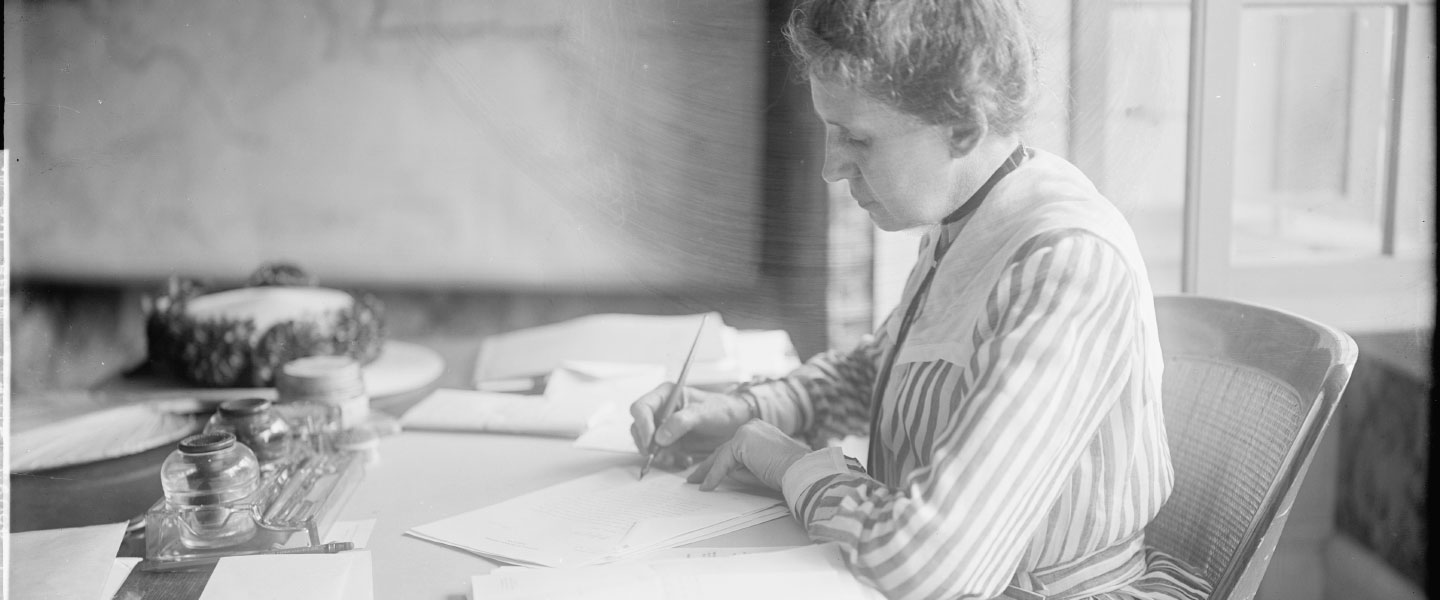
Ida Tarbell. Library of Congress
"There was born in me a hatred of privilege, privilege of any sort."
—Ida Tarbell, muckraking journalist, who saw her father's oil business autumn autonomously when she was fifteen, later on he refused a buyout from oil tycoon John D. Rockefeller
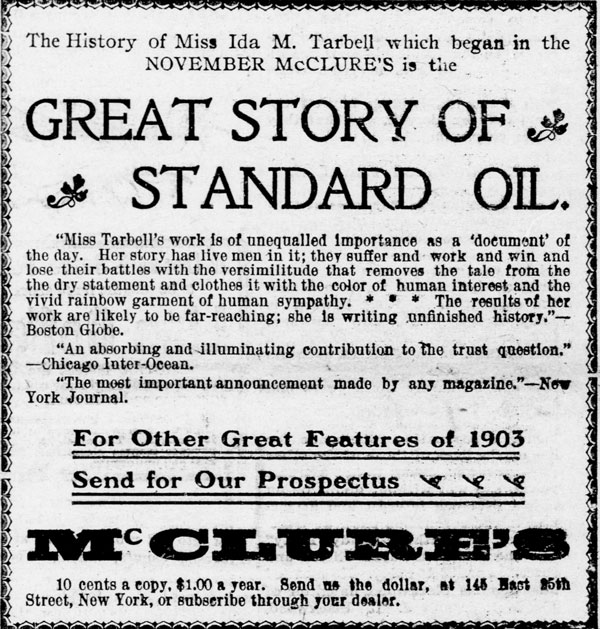
Advertisement in the Watertown Republican by McClure'south Magazine promoting Tarbell's exposé. Watertown, Wis., Jan. 10, 1903. Library of Congress
Essential Question
How did the muckrakers expose the corruption of the powerful?
Overview
Muckrakers were investigative journalists during the Progressive Era (1890s–1920s) who shone a light on corrupt business and government leaders as well as major social problems like racism.
Ida B. Wells wrote graphically about the horrors of lynching in the Due south. Her newspaper office was burned to the footing, and she was forced to movement to Chicago afterward her own life became imperiled. Jacob Riis photographed immigrant children who lived among the garbage dumps underneath the wharves in New York City. Upton Sinclair wrote The Jungle, revealing the unsafe and unsanitary atmospheric condition in the meatpacking industry. Ida Tarbell wrote about the monopolistic practices of John D. Rockefeller's Standard Oil Company, which destroyed modest businesses, including her father's.
Their reporting generated business concern among members of the public and lawmakers, and in some cases, led to laws that addressed the problems they were covering. In other cases, problems were exposed just the groundswell of emotion led to little change.
Context
The investigative techniques of the muckrakers included poring over documents, conducting countless interviews, and going secret. This differed from yellow journalism, where some leading newspapers sensationalized stories using imagination rather than facts. In several cases, muckrakers became activists themselves and spent years speaking throughout the land about their work and the demand for reform.
The term muckraking was coined by President Theodore Roosevelt in 1906, describing the crusading journalists who wrote stories in late nineteenth-century publications. Roosevelt took the word from the piece of work The Pilgrim's Progress by John Bunyan, written in 1678. Roosevelt criticized journalists he thought focused too much on exposing corruption in business and government and not reporting on more positive news. Journalists of the time largely took the term as a compliment and adopted it as a badge of honor for exposing misconduct.
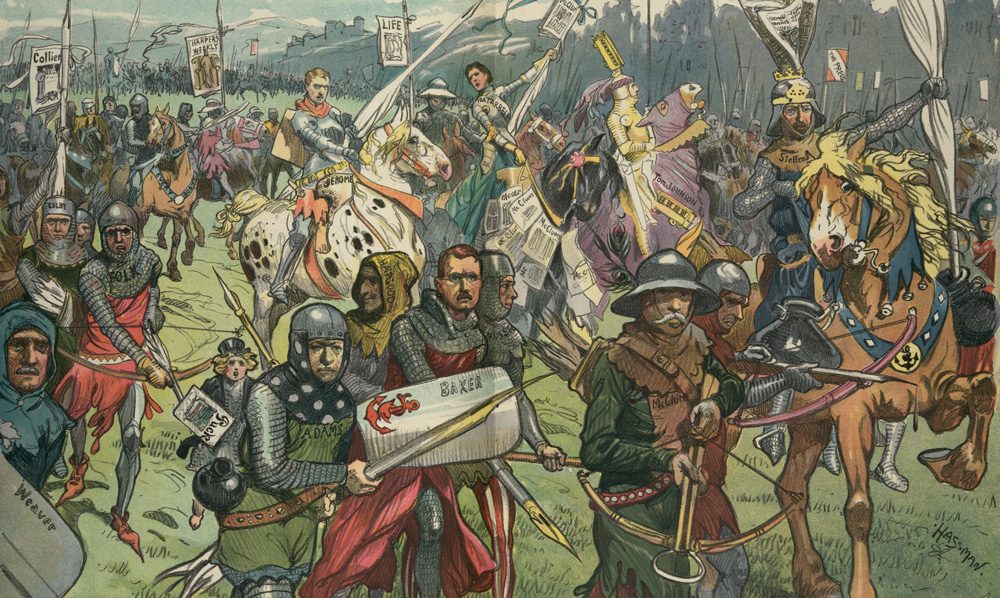
C. Hassman, The Crusaders, 1906. The analogy depicts a large grouping of politicians and journalists equally knights on a crusade against graft and corruption; many carry large pens like lances. Library of Congress
Discuss the post-obit questions:
- What are some examples of muckraking journalism during the Progressive Era?
- How did the investigative reporting of the muckrakers differ from the sensationalism of yellow journalism?
- What did President Theodore Roosevelt retrieve of muckraker journalism? How did these journalists meet themselves?
- How did photography such as Jacob Riis'south change the nature of journalism?
Journalist
Ida Tarbell was born on the oil frontier of western Pennsylvania in 1857. She was among the commencement women to graduate from Allegheny College in 1880. After trying her hand at the more traditional woman's job of educational activity, Tarbell became a freelance author and moved to Paris for over a decade before moving home and becoming editor of McClure's Magazine, a new reform-minded publication, in 1894. Her History of the Standard Oil Company, published in 1904, exposed the ruthless business methods of John D. Rockefeller. Information technology was a landmark work of the journalism that became known as "muckraking."
Jacob Riis was born in Denmark in 1849 and emigrated to the United States in 1870. He became a law reporter and with his camera, he began reporting on the harsh conditions of New York City'due south tenement life. Riis's pioneering techniques in investigative journalism and photojournalism laid the groundwork for social reform and supported efforts that were already underway. He published his works in books, newspapers, and magazines. In 1890, he published How the Other Half Lives, illustrated with photographs and statistics, which exposed the atrocious conditions in the streets and tenement housing of New York.
"Constabulary Lodging-Houses: Are They Hotbeds for Typhus Fever?" by J. A. Riis. Christian Marriage, Jan. 14, 1893. Library of Congress
Upton Sinclair was born in Baltimore, Maryland in 1878. Sinclair's parents raised him in contrasting worlds. His father was an alcoholic liquor salesman and his puritanical female parent came from the upper class. His family unit moved to New York Urban center when Upton was ten, and by age xiv, he was selling children's stories to magazines.
Rejecting his upper-course heritage, Sinclair became a socialist in 1903, and a year later fix out to expose the mistreatment of workers in the meatpacking industry. The project would become the book The Jungle, i of the first works of fiction to lead directly to national legislation. The Federal Meat Inspection Act and the Pure Nutrient and Drug Act of 1906 established the agency that eventually became the Nutrient and Drug Administration in 1930. The book raised cardinal questions about the abuses of mechanized product.
Discuss the post-obit questions:
- What might have been some of the difficulties Ida Tarbell faced in reporting on the ruthless business practices of the Standard Oil Company that other reporters didn't face up?
- How did Jacob Riis'due south employ of photography requite more impact to his reporting on the living conditions in New York's tenement housing?
- How did Upton Sinclair'south upper-class childhood give him a unique perspective to write most the mistreatment of workers in the meatpacking industry?
"Sinclair Tells Almost the Sufferings of the Women in Packingtown." The Evening World, New York, June 9, 1906. Library of Congress
News Format
In the Progressive Era (1890s–1920s), newspapers and magazines dominated the market with large audiences. In the cases of Riis and Tarbell, their piece of work appeared in newspapers or was serialized in magazines before they were turned into books. Sinclair published The Jungle, a work of fiction, which he and so turned into a serial of news articles.
The muckrakers' investigative focus grew out of the nineteenth century's age of "personal journalism" and "yellow journalism," which used a strong editorial vocalisation and was scandal focused, respectively. Many of the muckrakers came from both of these styles of journalism. And while xanthous journalism deservedly got a bad proper name for its tactics, wrongdoing was often exposed alongside the sensationalism, enraging the public, leading to borough discourse, and, in certain cases, policy change.
Photojournalism played a key role in muckrakers' piece of work. Newspapers published stirring and stunning photographs of child labor and inhumane factory conditions. Drawings of the photographs would also appear in newspapers due to cost and the technology available at the time. Come across if you tin make out the photo of the child in Riis'southward Evening Sun commodity in the left column below.
Discuss the following questions:
- What are some similarities and differences between the news formats of muckrakers and investigative reporting on network and cable television and the Internet today?
- Why was the sensationalism of muckraking and yellow journalism successful in gaining the public'southward attending regarding matters of reform?
Source: https://www.journalisminaction.org/case/ida-tarbell-muckraker
0 Response to "What Did Ida B. Wells Work to End Through Her Muckraking Articles?"
Postar um comentário